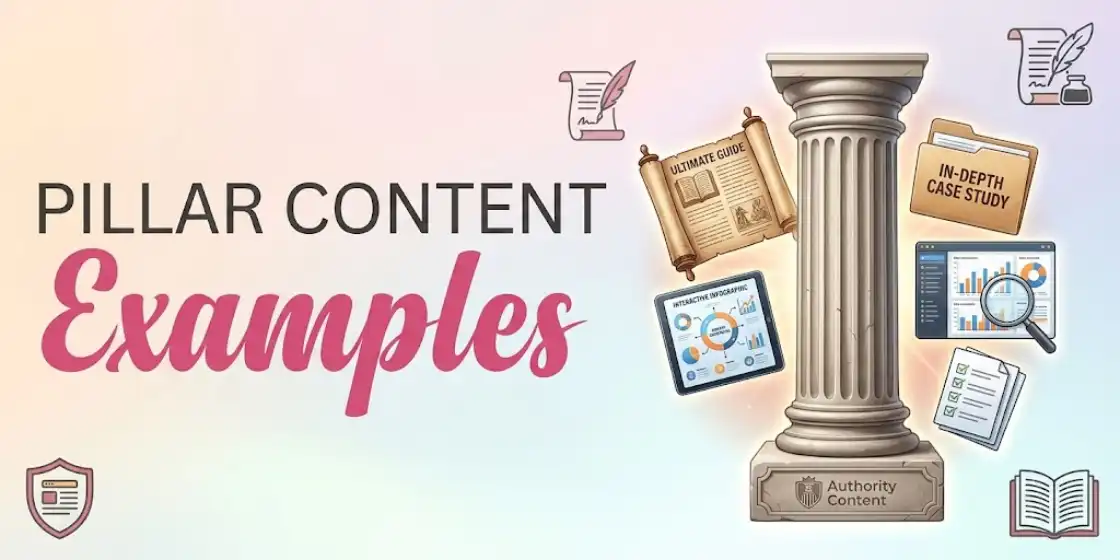
Google’s helpful content guidelines now reward sites that own a topic end-to-end, not sites that publish thin posts on every keyword under the sun. That single shift is why pillar content examples have become one of the most searched-for references among content marketers this year. A well-built pillar page can pull thousands of long-tail keywords into a single hub, feed your entire cluster of supporting articles, and keep readers on your site far longer than a standalone post ever could.
The trouble is, most marketers still confuse pillar content with a “really long blog.” It is not. A pillar is a strategic asset — planned, structured, and interlinked with intent. Below, we break down what pillar content actually is, walk through 10 real examples from brands doing it well, and hand you a framework you can copy for your own site.
What Is Pillar Content?

Pillar content is a comprehensive, long-form page that covers every major angle of a broad topic your brand wants to be known for. It is designed to answer the top-of-funnel question a reader might ask (for example, “what is email marketing?”), while linking out to shorter cluster or micro-content pieces that dig into the specific sub-topics.
Think of it as the trunk of a tree. The branches — your supporting blog posts — all connect back to it. This is closely related to what SEOs call cornerstone content, though a pillar is usually more visual, more navigational, and built with clusters in mind from day one.
A strong pillar page typically:
- Runs between 2,500 and 5,000+ words
- Uses a jump-nav or table of contents so readers can skim
- Targets a broad, high-volume “head” keyword
- Links out to 8–20 supporting cluster articles
- Gets updated regularly instead of being rewritten from scratch
What Is a Pillar Content Strategy?
A pillar content strategy is the plan that decides which topics deserve a pillar in the first place, which sub-topics become the supporting cluster, and how the internal linking will flow. Without this planning step, you end up with a bloated page that ranks for nothing in particular.
The strategy usually starts with content ideation — you brainstorm the core topics your audience actually searches for, then validate them with keyword volume data. From there you build out a content plan that pairs one head keyword (the pillar) with 10–20 secondary keywords (the clusters).
The gap most beginners miss: a pillar is not just a longer version of a blog post. It is a hub. That difference shapes everything — the layout, the internal links, and the way you write your blog intro and section headers.
4 Common Types of Pillar Content
Before we get to the examples, it helps to know that not every pillar looks the same. The four most common formats you will see in the wild are:
1. The Ultimate Guide
A top-to-bottom walkthrough of a broad topic (“The Ultimate Guide to Email Marketing”). Best for evergreen head terms with high search volume.
2. The “What Is X” Page
A definitional pillar that owns a category-defining question (“What Is CRM?”). These often rank in featured snippets and pull huge branded traffic.
3. The Resource Hub or Glossary
A directory-style page that links out to dozens of shorter definitions or tools. Mailchimp and Investopedia both do this well.
4. The Product-Led Pillar
A pillar that solves a real problem while naturally demonstrating how the product fits in. Notion and Zapier are known for this format.
10 Best Pillar Content Examples Worth Studying

These are the pillar pages we point clients to when they ask what “good” looks like. Each one nails something different — layout, depth, internal linking, or conversion — so treat this as a menu of tactics to steal from.
1. HubSpot — The Ultimate Guide to Instagram Marketing
HubSpot is still the benchmark. Their Instagram marketing pillar opens with a sticky table of contents, uses embedded video, and links out to 20+ related cluster posts covering everything from Reels to Instagram ads. What makes it work is the pacing — every section could stand alone, but each one ends by pushing you deeper into the cluster.
Steal this: the jump-nav pattern. On any pillar over 3,000 words, a sticky sidebar or an anchor-link menu at the top dramatically lifts time-on-page.
2. Mailchimp — Marketing Glossary
Mailchimp treats its entire Marketing Glossary like one giant pillar hub. Each glossary entry (What Is a Landing Page? What Is Segmentation?) is a mini-pillar in its own right, all interlinked. The design is clean, the copy is beginner-friendly, and every page ends with a soft product CTA.
Steal this: the glossary-as-pillar approach. If you sell in a jargon-heavy industry, you can rank for hundreds of “what is” queries with this exact template.
3. Notion — Product Launch Checklist
Notion’s product launch checklist is a masterclass in product-led content. Every step in the checklist (“plan your roadmap,” “gather feedback,” “coordinate the launch”) maps to a real Notion feature, but the article never feels like a sales pitch. Readers get a genuinely useful playbook, and the CTAs feel earned.
Steal this: build your pillar around a workflow your product already solves for. Show the solution instead of selling it.
4. Ahrefs — Keyword Research: The Beginner’s Guide
Ahrefs’ keyword research pillar has been ranking on page one for years, and there is a reason. It is written by a practitioner, uses screenshots from their own tool at every step, and turns a dry topic into something a beginner can finish in one sitting. The internal link block at the end funnels readers into 15+ related SEO guides.
Steal this: use original screenshots and real examples. AI-generated stock advice loses to hands-on, first-person walkthroughs every time.
5. Semrush — What Is SEO? The Beginner’s Guide
Semrush’s “What Is SEO” pillar owns one of the most competitive queries on the internet. Their play: chunky visuals, short paragraphs, an aggressive interlink strategy, and a top-of-page jump menu. They also update the page every few months, which keeps freshness signals strong.
Steal this: pick one truly big head term in your niche and commit to defending it. Refresh dates, screenshots, and stats every quarter.
6. Shopify — How to Start a Business
Shopify’s “how to start a business” pillar is enormous and structured almost like a mini-course. Sections are numbered, each has a takeaway box, and the internal linking pushes readers toward Shopify’s own tools (business name generator, logo maker, etc.) at exactly the right moment.
Steal this: build your pillar around your ideal customer’s biggest, scariest question. The higher the stakes, the more engagement long-form content earns.
7. Buffer — The Complete Guide to Social Media Marketing
Buffer’s social media marketing guide reads like a friend giving you advice. The tone is casual, the structure is scannable, and every chapter links out to a deeper Buffer resource. It is proof that pillar content does not need to be corporate or dry to rank.
Steal this: match the voice of your audience. B2B does not automatically mean bland.
8. Zapier — The Ultimate Guide to Remote Work
Zapier has been fully remote since day one, so their ultimate guide to remote work carries genuine authority. The page bundles original research, interviews with their own team, and links out to more than 30 cluster posts on productivity, async communication, and tooling.
Steal this: lead with proprietary data or first-hand experience. It is the one thing generic AI content cannot copy.
Keep your blog fresh and engaging with our professional writers!
Engage Readers
9. Canva — Design School
Canva’s Design School is technically a whole learning hub, but the structure follows every rule of pillar content: broad topic pages at the top, tightly focused tutorials underneath, and internal linking that keeps you clicking. It is what happens when a brand treats education as a moat.
Steal this: if you have the runway, build a resource hub rather than a single pillar. It compounds over time.
10. Salesforce — What Is CRM?
Salesforce owns “what is CRM” globally, and the pillar shows why. Clear definition up top, a stakeholder-friendly middle section (benefits, use cases, ROI), and a bottom half that quietly maps every reader concern to a Salesforce product line. Enterprise pillar content, done right.
Steal this: structure the page around the questions your sales team hears most. Search-intent research and sales conversations should agree.
Pillar Content vs Cornerstone Content: What Is the Difference?

These two terms get used interchangeably, but they are not quite the same thing. Cornerstone content is any evergreen page you want to rank for a primary term — it could be a landing page, a long guide, or even a well-updated blog post. A pillar is a specific format of cornerstone content: it is deliberately built as the hub of a topic cluster, with dedicated supporting posts that all link back to it.
Put simply: every pillar page is cornerstone content, but not every piece of cornerstone content is a pillar. If your evergreen page has no cluster of supporting articles feeding into it, it is cornerstone but not pillar. If you have a hub-and-spoke structure with 10+ supporting posts, you have a true pillar.
How to Create Your Own Pillar Content (5-Step Framework)
The examples above look effortless, but every one of them followed the same rough playbook. Here is the version we use for clients:
Step 1 — Choose a Topic You Can Actually Own
Pick a broad head term that (a) has real search volume, (b) is relevant to your product or service, and (c) is not already dominated by 10 near-identical pages. Use tools like Ahrefs, Semrush, or Google Search Console to validate demand before you write a word.
Step 2 — Map the Cluster
For every pillar, list 10–20 supporting questions. These become your cluster posts. A good prewriting strategy at this stage — outlining the pillar and every cluster before writing anything — saves you from major rewrites later.
Step 3 — Write the Pillar (Long, But Scannable)
Aim for 2,500–5,000 words, but structure it so a reader can skim in 60 seconds. Use short paragraphs, descriptive H2s and H3s, callout boxes, and images. If you need a refresher on how long a blog post should be, pillar content sits at the top end of that range on purpose.
Step 4 — Interlink Ruthlessly
The pillar links down to every cluster post. Every cluster post links back up to the pillar and sideways to 2–3 related clusters. This is the internal link topology Google rewards most.
Step 5 — Publish, Promote, Refresh
Push it on social, in your newsletter, and via outreach. Then diarize a refresh every 3–6 months — updated stats, new screenshots, and any new cluster posts added to the internal link section.
Common Pillar Content Mistakes to Avoid
- Treating it as one giant blog post. A pillar without a supporting cluster is just a long article.
- Chasing a keyword with no commercial value. High volume + zero buyer intent = a lot of traffic that never converts.
- Ignoring page speed. Long pages with unoptimized images tank Core Web Vitals fast.
- Publishing and forgetting. Pillars need to be maintained, not left to rot.
- Writing for search engines, not humans. If a real reader would not share it, Google will eventually stop ranking it too.
Frequently Asked Questions (FAQs)
| What is a content pillar? A content pillar is a long form content that is created to cover a broad aspect of any topic. It includes links to different clusters that allow readers to know about other related problems. |
| What is an ideal length of a content pillar? The ideal length of a content pillar is roughly around 3000 to 4000 words. It can increase more depending on the complexity of topic, and how deep you want to go to discuss any important subject. |
| How to create a content pillar strategy? To create a content pillar strategy, you must need to first prioritize a main keyword and then secondary keywords related to them. Then, you have to devise a prewriting strategy to cover them one by one, so that a content pillar can be completed timely. |
| Which content pillar examples are best to consider? You can find different types of content pillar examples available on the web. The best ones among them should have defined a complete pillar strategy, so try to find them keeping this key point in mind. |
| Why the content pillar strategy of HubSpot is worth to follow? The content pillar strategy of HubSpot is really nice. It has created a specific content pillar with the name “Instagram Marketing Guide” that gives a complete walkthrough into the marketing spectrum of Instagram. It has smartly included all the clusters in the content, making it a complete piece to read and follow. |
Final Words
The pillar content examples above have one thing in common: none of them were built as one-off blog posts. Each is a hub — a deliberate piece of infrastructure that pulls related content, internal links, and search intent into one place. That is what separates a pillar that ranks for years from a long article that quietly gets buried on page four.
If you are ready to plan your own, start with the framework above: pick a topic worth owning, map the cluster, and commit to the long game. And if you want a partner to build the pillar and its supporting cluster with you, our team has helped clients scale from a single pillar to a full topical map — get in touch and we’ll show you how.

Unleash your brand story`s potential with eContentSol – your creative writing companion. We craft narratives that captivate. Ready to elevate your content game? Dive into creativity with us and let`s bring your ideas to life.