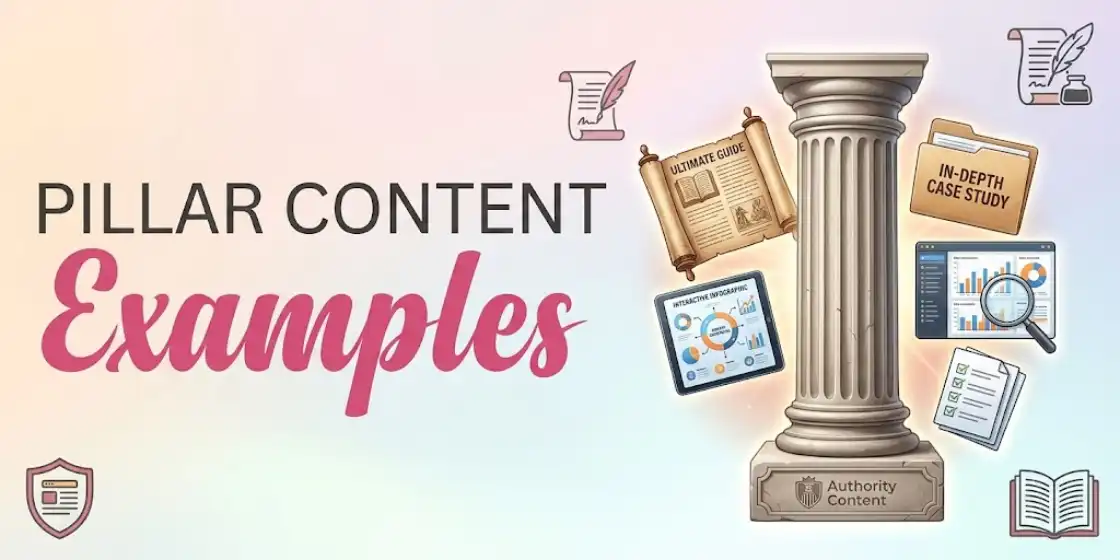
Search has split in two. Google still rewards sites that own a topic end to end, but AI Overviews, ChatGPT Search and Perplexity now answer a growing share of queries before anyone clicks. The pages these systems pull from tend to be structured, well linked and clearly authoritative. That is exactly what a good pillar page is.
That is why pillar content examples remain one of the most searched references among content marketers. A pillar is not a “really long blog post.” It is a planned, interlinked hub that ranks for broad terms, feeds a cluster of supporting articles, and gives both readers and AI systems a clean source to cite. Below, we cover what pillar content is, what has changed in 2026, 10 examples worth studying, and a framework you can copy.
Key Takeaways
- A pillar page is a comprehensive hub on one broad topic, linked to 8-15 focused cluster articles.
- In 2026 a pillar must work for humans and for AI extraction: answer-first sections, clear headings, tables and lists.
- Original experience, data and named authors matter more than length.
- Depth beats breadth: a few well-built clusters outperform many thin ones.
- Refresh pillars every quarter and track AI citations alongside rankings.
What Is Pillar Content?

Pillar content is a comprehensive page that covers every major angle of a broad topic your brand wants to be known for. It answers the top-level question a reader might ask, such as “what is email marketing?”, and links out to shorter cluster or micro-content pieces that cover specific sub-topics.
Think of it as the trunk of a tree, with your supporting posts as the branches. It is closely related to cornerstone content, but a pillar is more navigational and built with a cluster in mind from day one.
A strong pillar page typically:
- Runs between 2,500 and 5,000 words, and earns every one of them
- Opens each major section with a short, direct answer (40-60 words)
- Has a table of contents or jump navigation
- Targets a broad, high-volume head keyword
- Links to 8-15 supporting cluster articles, and each of them links back
- Is updated regularly instead of rewritten from scratch
What Is a Pillar Content Strategy?
A pillar content strategy decides which topics deserve a pillar, which sub-topics become the cluster, and how internal links will flow. Without it, you get a bloated page that ranks for nothing in particular.
It starts with content ideation: identify the core topics your audience searches for, validate them with keyword data, and now also check the questions people ask AI assistants. Then build a content plan that pairs one head keyword (the pillar) with 8-15 secondary keywords (the clusters). Most brands are better off with three to seven well-developed clusters than fifteen shallow ones.
How Pillar Content Has Changed in 2026
The core model still works. What has changed is what a pillar needs to do.
1. Answer first, then expand. Lead each H2 with a concise, factual answer, then add depth. This helps readers skim and gives AI systems clean passages to lift.
2. Structure for extraction. Use descriptive headings, bulleted lists for specs, and tables for comparisons. Every section should make sense on its own.
3. Show real experience. Google’s helpful content guidance and AI systems both favour first-hand knowledge. Add original data, screenshots, quotes from your team and named author bios.
4. Build topical authority, not just keyword coverage. Search engines increasingly judge whether your site covers a topic comprehensively. Bidirectional links between pillar and clusters make that coverage visible.
5. Avoid scaled, thin content. Publishing dozens of near-identical AI-generated posts to fill a cluster is a risk. Fewer, better pages win.
6. Measure more than rankings. Track organic traffic to the cluster as a whole, and check whether your pages are being cited in AI Overviews and AI assistants.
4 Common Types of Pillar Content
1. The Ultimate Guide
A top-to-bottom walkthrough of a broad topic. Best for evergreen head terms with high search volume.
2. The “What Is X” Page
A definitional pillar that owns a category-defining question (“What Is CRM?”). These often win featured snippets and are prime material for AI answers.
3. The Resource Hub or Glossary
A directory-style page that links to dozens of shorter definitions or tools. Mailchimp and Investopedia both use this format.
4. The Product-Led Pillar
A pillar that solves a real problem while showing how the product fits. Notion and Zapier are known for this.
10 Best Pillar Content Examples Worth Studying

These are the pillar pages we point clients to when they ask what good looks like. Each nails something different, so treat this as a menu of tactics to borrow.
1. HubSpot: The Ultimate Guide to Instagram Marketing
HubSpot popularised the topic cluster model, and its Instagram marketing pillar shows why. It combines a navigable structure, mixed media and links to related cluster content, so a reader can start broad and go deep.
Steal this: jump navigation. On any pillar over 3,000 words, anchor links help readers and make sections easier for search engines to parse.
2. Mailchimp: Marketing Glossary
Mailchimp treats its Marketing Glossary as one big hub. Each entry is a small pillar in its own right, written in beginner-friendly language and interlinked with the rest.
Steal this: the glossary-as-pillar approach. In a jargon-heavy industry it lets you own many “what is” queries, which is also the format AI assistants draw on most.
3. Notion: Product Launch Checklist
Notion’s product launch checklist maps each step to a workflow its product supports, without reading like a sales pitch.
Steal this: build your pillar around a workflow your product already solves. Show, don’t sell.
4. Ahrefs: Keyword Research, The Beginner’s Guide
Ahrefs’ keyword research guide is written by practitioners and illustrated with real screenshots from their own tool.
Steal this: original screenshots and first-hand walkthroughs. They are hard for generic content to copy.
5. Semrush: What Is SEO?
Semrush’s What Is SEO guide goes after one of the most competitive head terms in marketing, with short paragraphs, strong visuals and heavy internal linking.
Steal this: pick one big head term and defend it by refreshing stats and screenshots every quarter.
6. Shopify: How to Start a Business
Shopify’s how to start a business guide is structured like a mini course, with numbered sections and links to Shopify tools at the moment a reader needs them.
Steal this: anchor your pillar on your customer’s biggest, scariest question.
7. Buffer: The Complete Guide to Social Media Marketing
Buffer’s social media marketing guide reads like advice from a friend: casual, scannable, and linked to deeper resources chapter by chapter.
Steal this: match your audience’s voice. B2B does not have to be bland.
8. Zapier: The Ultimate Guide to Remote Work
Zapier has been remote-first for years, so its remote work guide carries real authority, backed by its own team’s experience and links to related productivity content.
Steal this: lead with proprietary data or lived experience. It is the one thing generic AI content cannot copy.
Keep your blog fresh and engaging with our professional writers!
Engage Readers
9. Canva: Design School
Canva’s Design School is a full learning hub, but it follows the pillar rules: broad topic pages on top, focused tutorials underneath, and links that keep readers moving.
Steal this: if you have the runway, build a resource hub rather than a single pillar. It compounds.
10. Salesforce: What Is CRM?
Salesforce’s What Is CRM page opens with a clear definition, then covers benefits, use cases and ROI for different stakeholders.
Steal this: structure the page around the questions your sales team hears most.
Pillar Content vs Cornerstone Content: What Is the Difference?

Cornerstone content is any evergreen page you want to rank for a primary term: a landing page, a long guide or a well-maintained post. A pillar is a specific kind of cornerstone content, built as the hub of a topic cluster with dedicated supporting posts linking back to it.
Every pillar is cornerstone content, but not all cornerstone content is a pillar. With no cluster feeding into it, it is cornerstone. With a hub-and-spoke structure and 8-15 supporting posts, it is a true pillar.
How to Create Your Own Pillar Content (5-Step Framework)
Step 1: Choose a Topic You Can Actually Own
Pick a broad head term that has real demand, fits your product or service, and is not dominated by near-identical pages. Validate it with Ahrefs, Semrush or Google Search Console, and check which questions AI assistants answer about it.
Step 2: Map the Cluster
List 8-15 supporting questions. These become your cluster posts. A solid prewriting strategy helps you outline the pillar and every cluster before writing.
Step 3: Write the Pillar (Deep, But Scannable)
Aim for 2,500-5,000 words, but open each section with a direct answer, use descriptive H2s and H3s, add tables and lists, and include original examples, data and a named author. See how long a blog post should be for context.
Step 4: Interlink Both Ways
The pillar links down to every cluster post. Every cluster links back up to the pillar and sideways to 2-3 related clusters, using descriptive anchor text.
Step 5: Publish, Promote, Refresh
Promote through social, email and outreach. Then refresh every 3 months: update stats, swap screenshots, add new clusters, and change the “last updated” date only when you have genuinely improved the page.
Common Pillar Content Mistakes to Avoid
- Treating it as one giant blog post. A pillar without a cluster is just a long article.
- Chasing volume with no buyer intent. Traffic that never converts is a vanity metric.
- Filling clusters with thin, mass-produced posts. Depth beats quantity.
- Ignoring page speed. Long pages with heavy images hurt Core Web Vitals.
- Publishing and forgetting. Stale stats erode trust with readers and AI systems alike.
- Writing only for search engines. If a reader would not share it, it will not last.
Frequently Asked Questions (FAQs)
| What is a content pillar? A content pillar is a comprehensive page covering a broad topic, linked to a cluster of supporting articles that go deeper on each sub-topic. |
| What is the ideal length of a content pillar? Most pillars run 2,500 to 5,000 words. Length should follow the topic’s complexity, not a word count target. |
| How do I create a content pillar strategy? Choose a broad topic, pick a primary keyword, map 8-15 cluster topics, outline everything with a prewriting strategy, then publish and interlink the pillar and clusters. |
| Do pillar pages help with AI Overviews and ChatGPT? They can. Well-structured, authoritative pillars with clear answers and strong internal linking give AI systems clean, attributable content to cite. Strong organic rankings remain a solid foundation. |
| How often should I update a pillar page? Review it every 3 months and update stats, examples and screenshots. Add new cluster posts to the internal links as you publish them. |
| Why is HubSpot’s pillar strategy worth following? HubSpot helped popularise the topic cluster model and consistently pairs broad guides with linked, focused supporting content. |
Final Words
Every pillar content example above shares one trait: none was built as a one-off blog post. Each is a hub, deliberate infrastructure that connects related content, internal links and search intent. In 2026 that hub also has to be easy for AI systems to read and trust.
Start with the framework: pick a topic worth owning, map the cluster, write answer-first, and refresh often. If you want a partner to build the pillar and its supporting cluster, our team can help you go from a single pillar to a full topical map. Get in touch and we will show you how.

Unleash your brand story`s potential with eContentSol – your creative writing companion. We craft narratives that captivate. Ready to elevate your content game? Dive into creativity with us and let`s bring your ideas to life.