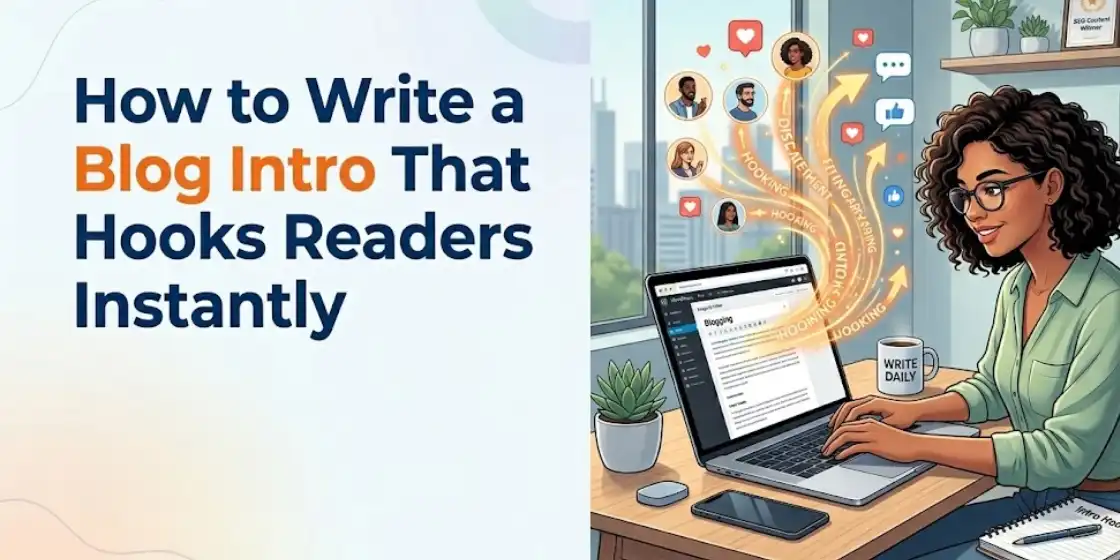
Your blog introduction is the make-or-break moment of every article you publish. Research consistently shows that the average reader decides within 10 seconds whether to keep reading or hit the back button. If your blog intro fails to grab attention, it does not matter how well-researched or insightful the rest of your post is — nobody will stick around to read it.
That is the reality most writers face, especially those who are still learning how to come up with blog ideas and translate them into published content. You have the knowledge. You have done the research. But when it comes to writing those opening lines, the cursor just blinks.
This guide breaks down exactly how to write a blog intro that captures attention, builds curiosity, and convinces readers to stay. You will see real blog introduction examples, learn a repeatable framework you can use on any topic, and walk away with a process that turns blank-page anxiety into confident, compelling openings every time.
What Is a Blog Introduction and Why Does It Matter?

A blog introduction is the opening section of your article — typically the first one to three paragraphs before you dive into your main headings. Its job is simple but critical: set the context, establish relevance, and give the reader a reason to continue.
Think of your blog intro as a bridge between the headline that brought someone to the page and the body content that delivers the real value. A strong article always earns its readership in these first few lines.
A well-crafted blog introduction accomplishes three things:
- Validates the reader’s intent. It confirms they are in the right place and that the article addresses what they searched for.
- Creates an information gap. It hints at what the reader will learn without giving everything away, triggering curiosity.
- Establishes credibility. It signals that the writer understands the topic and the reader’s situation.
When your blog introduction fails at any of these, bounce rates climb and engagement drops — regardless of how good the rest of your content is. This is why understanding what makes a good introduction for your blog post is foundational to every content strategy, whether you are writing SEO-friendly blog posts or thought leadership pieces.
How to Write a Blog Intro: A 6-Step Framework

The following framework gives you a repeatable structure for creating an amazing introduction for your blog post — regardless of the topic, niche, or audience. Each step builds on the previous one, so your intro flows naturally from the first sentence to the transition into the body.
Step 1: Open With the Reader’s Problem
The fastest way to hook someone is to describe the exact problem they are experiencing right now. When a reader sees their own frustration reflected back at them in the first sentence, something clicks — they feel understood, and that emotional connection keeps them reading.
This is one of the most effective prewriting strategies for blog content: before you write a single word of the introduction, identify the core pain point your audience has and lead with it. Ask yourself: what is the reader feeling or struggling with right before they typed their search query?
Example:
“You have spent hours researching your topic, outlining every section, and polishing your arguments — but you are still staring at a blank introduction, unsure how to begin.”
Notice how this speaks directly to the experience. It does not start with a dictionary definition or a vague statement about why blogs matter. It mirrors the reader’s actual situation.
Step 2: Add Emotional Resonance
After naming the problem, amplify it with emotion. This does not mean being dramatic — it means using tone of voice and power words that make the reader feel the weight of the issue. Frustration, excitement, relief, urgency — the right emotional register depends on your topic and audience.
A blog about productivity tools might lean into the frustration of wasted time. A blog about travel might open with the excitement of possibility. The key is choosing words that resonate emotionally, not just intellectually.
Example:
“It is one of the most frustrating parts of blogging — knowing exactly what you want to say in the body of your post, but feeling completely stuck when it comes to writing those first few sentences.”
Step 3: Boost Their Hopes
Once you have acknowledged the pain and the emotion, pivot toward hope. This is where you signal that a solution exists — that the reader’s problem is solvable and they are about to learn how.
This shift in energy is what keeps readers moving from the introduction into the body of the article. Without it, you risk leaving them in the problem without a reason to keep reading.
Example:
“But here is the thing — writing a compelling blog intro is a learnable skill, not a talent you are born with. Once you understand the structure, it becomes the easiest part of the writing process.”
Step 4: Introduce Your Core Solution
Now bridge the gap between the problem and the content. In one to two sentences, describe what the article delivers. Be specific — vague promises like “we will cover everything you need to know” do not build confidence or curiosity.
Your solution statement should make the reader think: “This is exactly what I need.”
Example:
“This guide walks you through a proven 6-step framework for writing blog introductions that hook readers from the first line — complete with examples you can adapt to any niche.”
Step 5: Highlight the Key Benefits
Tell the reader what they will gain by reading the full article. Benefits are different from features: features describe what the article covers, while benefits describe how the reader will be better off after reading it. This is a principle borrowed from direct response copywriting — always lead with the outcome the reader cares about.
Example:
“By the end, you will have a repeatable process that eliminates blank-page anxiety, a library of intro templates you can reuse, and the confidence to write openings that keep readers engaged.”
Step 6: Make a Promise
Close your introduction with a confident, outcome-focused promise. This acts as a verbal handshake — a commitment that the article will deliver on what you have set up. Strong promise statements use direct, active language:
- “Let me show you exactly how it is done.”
- “It is a lot simpler than you think.”
- “Here is the step-by-step process.”
These short statements — sometimes called bucket brigades — work as transition words that propel the reader from the intro into the main content. They reinforce your authority and give the reader confidence that their time will be well spent.
Blog Introduction Examples: Before and After

Seeing the framework in action makes it much easier to internalize. Below are three blog introduction examples across different topics, showing how the same 6-step structure adapts to different niches.
Example 1: Fitness Blog Intro
Before (Weak):
“In this article, we will discuss some tips for losing weight. Weight loss is a common goal that many people have. There are many approaches you can try.”
After (Using the Framework):
“You have tried calorie counting, intermittent fasting, and cutting carbs — but the scale has not budged in weeks. It is demoralizing, especially when you are putting in real effort. The truth is, most weight loss stalls come down to one overlooked factor. This guide reveals what it is and gives you a simple 4-week plan to break through your plateau. No fad diets, no extreme workouts — just a science-backed approach that works.”
Example 2: Marketing Blog Intro
Before (Weak):
“Email marketing is very important for businesses. In this blog post, we will talk about how to write better emails.”
After (Using the Framework):
“Your email open rates are dropping, your click-throughs are flat, and your unsubscribe numbers keep creeping up. Sound familiar? Most email marketers face this exact pattern — and it almost always traces back to the same root cause: generic, one-size-fits-all messaging. In this guide, you will learn a segmentation-first approach to email copywriting that has helped brands double their engagement in 90 days. Here is the exact playbook.”
Example 3: Tech Blog Intro
Before (Weak):
“ATS resumes are becoming more popular. Let us look at how they work and why you need one.”
After (Using the Framework):
“You submitted 50 applications last month and got zero callbacks. Before you blame the job market, consider this: up to 75% of resumes are filtered out by applicant tracking systems before a human ever sees them. If your resume is not formatted for ATS, you are invisible. This guide shows you exactly how to build an ATS-friendly resume that passes automated screening and lands interviews — step by step.”
Blog Introduction Templates You Can Reuse

If you want a quick starting point, these blog introduction templates adapt the 6-step framework into fill-in-the-blank formats you can use immediately.
Template 1: The Problem-Solution Intro
“You have been struggling with [specific problem] — and you are not alone. [Statistic or common experience]. The good news? [Promise of solution]. In this guide, you will learn [what the article covers] so you can [key benefit].”
Template 2: The Question Hook Intro
“What if you could [desirable outcome] without [common obstacle]? Most [audience] assume that [common misconception]. But [surprising truth]. This article breaks down [what the article delivers], starting with [first key topic].”
Template 3: The Story-Driven Intro
“When [relatable scenario happened], [emotional reaction]. It is a situation that [audience type] know all too well. After [what you did to find a solution], here is what actually works — and how you can apply it starting today.”
These templates work across niches — from food blogs to fitness blogs to technical content. Adapt the language to match your audience and tone.
Common Blog Intro Mistakes to Avoid
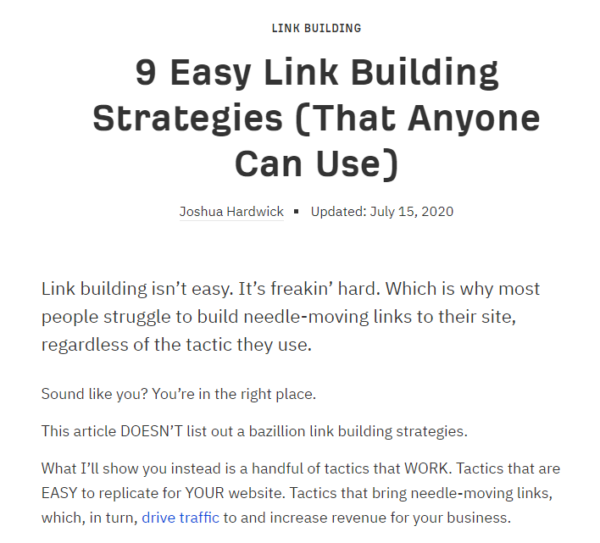
Even experienced writers fall into these traps. Avoiding them will immediately improve your blog introductions.
Starting With a Definition
Opening with “According to Wikipedia…” or “[Topic] is defined as…” signals lazy writing and gives the reader no reason to care. Instead, start with the reader’s experience, not a textbook definition.
Being Too Vague
Phrases like “In this article, we will discuss…” or “There are many ways to…” are fluff in writing that waste the reader’s time. Be specific about what you are covering and what the reader will gain.
Writing Too Long
A blog introduction should be 75 to 150 words — long enough to establish context and curiosity, short enough to respect the reader’s time. If you are approaching 200 words, you are probably including information that belongs in the body. Knowing the ideal paragraph length helps here.
Burying the Hook
If the most interesting part of your intro is in the third paragraph, move it to the first sentence. The hook must come immediately — before the reader’s attention wanders.
Overpromising
Promising results your article cannot deliver destroys trust. If your blog post offers a framework, do not claim it will “change your life forever.” Match the promise to the actual content.
How Blog Intros Fit Into Your Larger Content Strategy
Your blog introduction does not exist in isolation — it is part of a larger content ecosystem. When you are creating a content plan, your introductions should be tailored to the intent behind each piece. An introductory blog post designed to attract top-of-funnel traffic needs a different opening than a long-form deep dive aimed at experts.
For cornerstone content and content pillars, the introduction carries even more weight because these pages need to rank for competitive head terms and serve as hubs that link out to supporting articles. A strong blog intro on a pillar page sets the scope for the entire topic cluster.
If you are writing listicles, the intro should quickly establish what the list covers, who it is for, and why the reader should trust your selections. For opinion-driven content, use the intro to stake your claim early so the reader knows where you stand.
Quick Checklist: Is Your Blog Intro Ready to Publish?
Before you hit publish, run your introduction through this checklist:
- Does the first sentence address the reader’s problem or situation directly?
- Is there an emotional hook — frustration, curiosity, excitement, or urgency?
- Does the intro signal that a solution exists?
- Is the article’s scope and promise clearly stated?
- Are the benefits of reading the full article explicit?
- Is it under 150 words?
- Does it transition smoothly into the first body section?
- Would you keep reading if you landed on this intro from a Google search?
Final Thoughts
Learning how to write a blog intro is one of the highest-leverage skills you can develop as a content creator. The 6-step framework — problem, emotion, hope, solution, benefits, promise — gives you a reliable structure that works across every niche and format. Pair it with the templates and examples in this guide, and you will never stare at a blank introduction again.
The key is practice and iteration. Write your introductions, test them with real audiences, and refine based on what performs. Over time, you will develop an instinct for what hooks readers — and that instinct will make every piece of content you produce stronger.
If you need professional help crafting blog content that ranks and converts, our content writing team specializes in creating high-performance articles built on data-driven SEO strategies and proven writing frameworks.

Unleash your brand story`s potential with eContentSol – your creative writing companion. We craft narratives that captivate. Ready to elevate your content game? Dive into creativity with us and let`s bring your ideas to life.